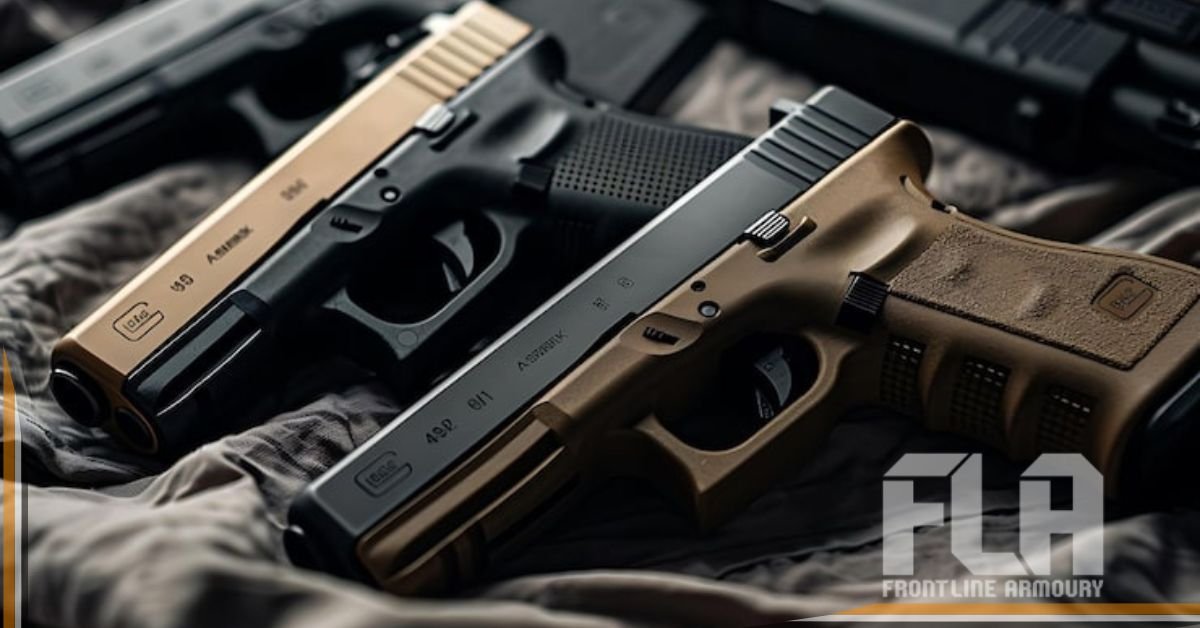
Glock pistols are among the most recognized and widely used firearms in the world, trusted by both civilians and law enforcement. However, their popularity has also sparked several myths that can confuse buyers. At Frontline Armoury, we want to provide clear, fact-based information so you can make the best decision.
In this article, we’ll debunk some of the most common Glock myths using technical data and expert insights.
Myth 1: “Glocks don’t have a safety, so they’re dangerous.”
The Truth: Glocks feature an advanced safety system called Safe Action.
One of the biggest myths is that Glocks are unsafe because they lack a manual thumb safety. The reality is they have an integrated safety system that works differently than traditional firearms.
The Safe Action system consists of three automatic, independent safeties:
- Trigger Safety: Prevents the trigger from moving unless it is fully pressed.
- Firing Pin Safety: Blocks the firing pin from moving forward unless the trigger is pulled.
- Drop Safety: Ensures the gun won’t fire if it’s dropped or hit with force.
The Bottom Line: Glocks are incredibly safe when handled properly. The design prevents accidental discharges without the need for a manual switch.
Myth 2: “Glocks are just plastic and aren’t durable.”
The Truth: They are made with high-strength reinforced polymer and are extremely tough.
While Glocks aren’t all-metal, their reinforced polymer frame makes them lightweight and incredibly resistant to impacts, corrosion, and extreme temperatures.
In extreme torture tests, Glocks have proven to handle:
- Freezing and high-heat environments without failing.
- Sand, mud, and water without jamming.
- Thousands of consecutive rounds without losing reliability.
The Bottom Line: Glock’s polymer is a technological innovation that increases the gun’s durability without sacrificing performance.
Myth 3: “Glocks are less accurate than other brands.”
The Truth: Their accuracy is excellent and depends more on the shooter than the gun.
Some people believe Glocks can’t compete in the accuracy department, but shooting experts agree that accuracy comes down to training.
Glocks are engineered with:
- High-quality barrels for consistent shot placement.
- Uniform trigger pulls that are ideal for developing better shooting habits.
- Efficient ergonomics that help manage recoil and maintain control.
Models like the Glock 34 are staples in the competition world, proving that in trained hands, a Glock is exceptionally accurate.
The Bottom Line: With the right practice and technique, a Glock is just as accurate—if not more so—than other big-name brands.
Myth 4: “Every Glock is basically the same.”
The Truth: Glock offers a massive variety of models tailored to specific needs.
Not all Glocks are built for the same job. While they share a similar look, there are key differences based on their intended use:
| Model | Key Features | Recommended Use |
| Glock 19 | Compact, 15+1 rounds | Personal defense and CCW |
| Glock 17 | Standard size, 17+1 rounds | Duty use and tactical |
| Glock 43X | Slimline, 10+1 rounds | Discrete concealed carry |
| Glock 34 | Longer barrel, high precision | Competition and sport shooting |
The Bottom Line: There is a specific Glock for every need, from daily protection to precision shooting.
Ready to choose your Glock? Visit us at Frontline Armoury
If you’re looking for professional advice and a wide selection of Glocks in Miami, come see us at Frontline Armoury. Our team will help you find the perfect model for your lifestyle.